10 Dishes to Try Before Leaving Rajasthan
Rajasthan isn't a place you simply visit.
You experience it.
Through the sound of folk music in a courtyard.
Through the colours of a bazaar.
Through the silence of the Thar.
And, perhaps most memorably, through a plate of food placed in front of you with a generous amount of ghee.
Because if you've travelled all the way to Rajasthan and survived without trying its food, did you really experience Rajasthan?
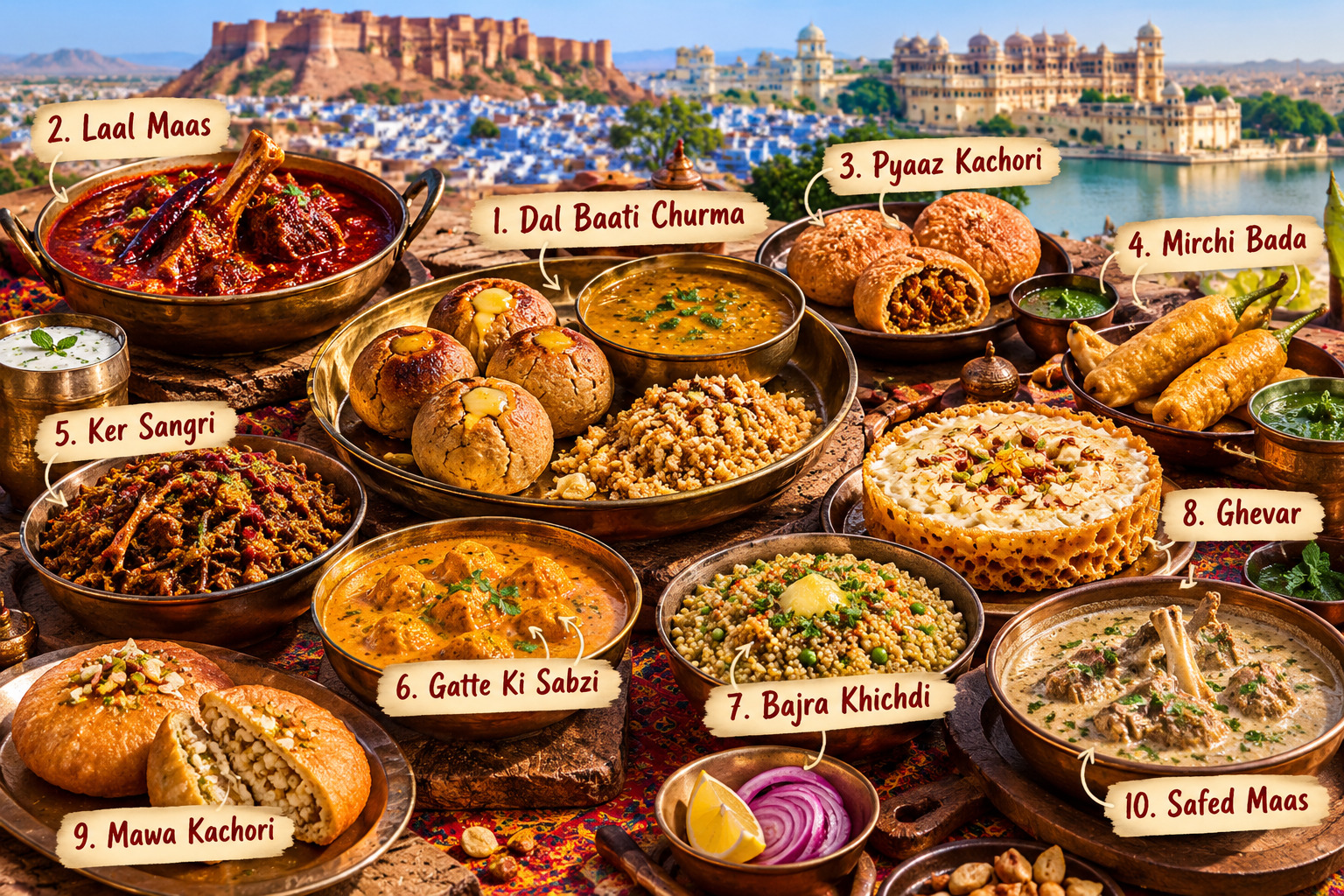
From the legendary Dal Baati Churma to fiery Laal Maas, crispy Pyaaz Kachori, desert-born Ker Sangri and delicate Ghevar, Rajasthani cuisine has evolved around the state's landscape, ingredients, traditions and history. Rajasthan Tourism describes the cuisine as varying across the state while highlighting dishes such as Dal Baati Churma, Laal Maas, Kachoris, Mirchi Bada, Ghevar and Ker Sangri.
So before you pack your bags, check your itinerary one more time.
Because these are 10 dishes worth making room for.
1. Dal Baati Churma — The Dish You Cannot Leave Rajasthan Without Trying
If Rajasthan had to choose one dish to introduce itself, Dal Baati Churma would probably be it.
It isn't just one preparation.
It's a combination of three very different things:
Dal — spiced lentils
Baati — baked wheat dough balls
Churma — sweet, crumbly crushed wheat
And then comes the part that makes first-time visitors understand why Rajasthani food has such a reputation:
ghee.
Lots of it.
Traditional baati is served hot, often broken open and accompanied by dal, chutneys and churma. Rajasthan Tourism describes it as one of the state's most savoured complete meals, traditionally accompanied by spicy garlic chutney and other accompaniments.
The magic is in the contrast.
The dal is savoury and spiced.
The baati is hearty and slightly crisp outside.
The churma brings sweetness.
And ghee ties everything together.
Where should you try it?
Look for a traditional Rajasthani restaurant or thali experience in Jaipur, Jodhpur, Udaipur or Jaisalmer.
Bas Chalo Tip
Don't order only baati.
Ask for the complete Dal Baati Churma experience.
That's the point.
2. Laal Maas — Rajasthan's Fiery Side
If Dal Baati Churma represents the comforting side of Rajasthan, Laal Maas represents its fire.
This traditional mutton curry is known for its deep red appearance and intense chilli-forward character.
Rajasthan Tourism describes Laal Maas as a traditional red, spicy mutton curry associated with royal kitchens, while Incredible India highlights its preparation with mutton, red chillies and spices and its traditional pairing with breads such as bajra roti.
But here's the important part:
Don't order it simply because it looks dramatic.
Laal Maas is about flavour as much as heat.
A good preparation should have layers of spice, richness and slow-cooked meat rather than being nothing more than a chilli attack.
Where to look for it
Jodhpur, Jaipur and Udaipur are good places to look for traditional versions.
Who should try it?
? Non-vegetarians
?️ Spice lovers
? Travellers curious about Rajasthan's royal culinary traditions
Bas Chalo Tip
If you're sensitive to spice, ask about the heat level before ordering.
Your stomach doesn't care that you're on vacation.
3. Pyaaz Kachori — Rajasthan's Perfect Breakfast Problem
You wake up.
You are hungry.
You smell something frying.
You follow the smell.
Five minutes later:
Pyaaz Kachori.
This is how many Rajasthan mornings should begin.
Pyaaz Kachori is a crisp, deep-fried pastry filled with a spiced onion mixture. Rajasthan Tourism identifies it as one of the state's famous kachori varieties, while Incredible India describes it as a flaky fried pastry with a spicy onion filling.
The outside is crisp.
The filling is spicy and aromatic.
And the chutney makes everything better.
It's particularly associated with the food culture of cities such as Jaipur and Jodhpur, although you can find variations throughout Rajasthan.
The best time to eat it?
Morning.
Or afternoon.
Or evening.
Actually, forget the schedule.
If you're standing next to a good kachori shop and it's fresh:
eat it.
4. Mirchi Bada — For People Who Think They Can Handle Spice
Rajasthan has another answer to the question:
“Can you make a snack more exciting?”
Take a large green chilli.
Stuff it.
Coat it in gram-flour batter.
Deep fry it.
Serve it hot.
Mirchi Bada.
The traditional preparation combines chilli with a potato-based filling and gram-flour coating before frying. Rajasthan Tourism specifically highlights Mirchi Bada as a popular snack, particularly associated with Jodhpur.
The result?
Crispy outside.
Soft inside.
Spicy somewhere in between.
And dangerously easy to finish.
Where to try it
If you're travelling through Jodhpur, put this on your food list.
Bas Chalo Tip
Pair it with chai.
Because apparently Rajasthan decided that tea time needed an adrenaline rush.
5. Ker Sangri — The Taste of the Thar Desert
This might be the dish that surprises you the most.
Because Ker Sangri doesn't look like the kind of food you'd expect from a desert.
And that's exactly why you should try it.
Ker is a desert berry.
Sangri comes from the pods of the khejri tree.
Together they become one of Rajasthan's most distinctive traditional preparations.
Rajasthan Tourism describes Ker Sangri as a combination of ker berries and sangri beans, cooked with spices such as red chilli and carom seeds. Rajasthan Foundation also lists it among traditional Rajasthani foods.
It's tangy.
Spicy.
Earthy.
And unlike many dishes you've probably eaten before.
More importantly, it tells a story about Rajasthan itself.
A cuisine shaped by an arid environment and ingredients that could thrive in difficult conditions.
Where to try it
Look for Ker Sangri in a traditional Rajasthani thali, especially in Jodhpur, Jaipur and Udaipur.
Bas Chalo Tip
Don't skip it just because you've never heard of it.
That's precisely why you should order it.
6. Gatte Ki Sabzi — The Vegetarian Classic
Imagine you're travelling through Rajasthan and someone puts a bowl of curry in front of you.
You take a bite.
You discover there isn't a traditional vegetable hiding inside it.
Instead, the main ingredient is besan.
Welcome to Gatte Ki Sabzi.
Gatte are gram-flour dumplings that are cooked and served in a spiced gravy, commonly with a yoghurt-based element. Rajasthan Tourism lists both Gatte Ki Khichdi and Shahi Gatte among the state's traditional preparations, while Incredible India includes Gatte Ki Sabzi among the traditional foods of Rajasthan.
The texture makes this dish special.
The gatte are firm enough to bite into but absorb the flavour of the gravy.
Serve it with:
? Rice
? Roti
? Rajasthani thali
Why you should try it
Because it demonstrates one of the most interesting things about Rajasthani cuisine:
you don't need a huge variety of fresh vegetables to create huge variety in food.
7. Bajra Khichdi — Simple, Hearty and Deeply Rajasthani
Not every great travel meal needs to be complicated.
Sometimes it's a bowl of something warm and comforting.
Bajra Khichdi is made using pearl millet and is part of Rajasthan's traditional food culture.
Incredible India highlights Bajra Khichdi among the traditional foods associated with Rajasthan and specifically mentions it in its Udaipur culinary guide.
Bajra gives it a distinctive earthy character.
It works particularly well when paired with other traditional accompaniments.
And after a long day exploring forts, markets and streets, this kind of food can feel exactly right.
Best for:
? Traditional-food lovers
? Comfort-food fans
? Travellers wanting something different from restaurant-heavy meals
8. Ghevar — Rajasthan's Sweetest Celebration
Now it's time for dessert.
And Rajasthan doesn't believe in subtlety.
Enter:
Ghevar.
This distinctive disc-shaped sweet is made from flour and soaked in sugar syrup, with variations including plain, mawa and malai ghevar. Rajasthan Tourism notes its strong association with festivals such as Teej and Raksha Bandhan.
The texture is part of the attraction.
Light.
Crispy.
Honeycomb-like.
Then comes the richness.
Depending on the version, you'll find toppings or layers involving malai or mawa.
Incredible India also describes Ghevar as a traditional Rajasthani sweet particularly associated with festive occasions.
Where to try it
Jaipur is particularly associated with Ghevar, although you'll find it across Rajasthan.
Bas Chalo Tip
If you see:
Malai Ghevar
don't overthink it.
Just order one.
9. Mawa Kachori — Because Rajasthan Refused to Keep Kachori Savoury
You've already eaten Pyaaz Kachori.
You think you understand kachori.
Then Rajasthan introduces:
Mawa Kachori.
Instead of a spicy onion filling, this version turns the kachori into a dessert.
Mawa.
Nuts.
Sweetness.
Crispy pastry.
Rajasthan Tourism identifies Mawa Kachori as one of the state's notable sweet kachori varieties.
And this is where Rajasthan's food becomes wonderfully mischievous.
You thought:
“Kachori = breakfast.”
Rajasthan says:
“Not necessarily.”
Best time to try it
Anytime you have room after a savoury meal.
Which is difficult.
But necessary.
10. Safed Maas — The Royal Curry You Shouldn't Ignore
If Laal Maas is the famous fiery curry, Safed Maas offers a very different experience.
The name literally refers to its pale appearance.
Rajasthan Tourism describes Safed Maas as a lamb curry with a creamy white sauce featuring ingredients such as onion, ginger, garlic, pepper and cardamom.
It's richer and more delicate in character than the chilli-driven profile associated with Laal Maas.
And that's why trying both makes sense.
Laal Maas
?️ Fiery
? Bold
? Chilli-forward
Safed Maas
? Creamy
? Aromatic
? Rich
Together, they offer a glimpse into the range of Rajasthan's meat-based culinary traditions.